Camaro SS in Britain: The V8 You Can Still Wrench On Your Own Drive
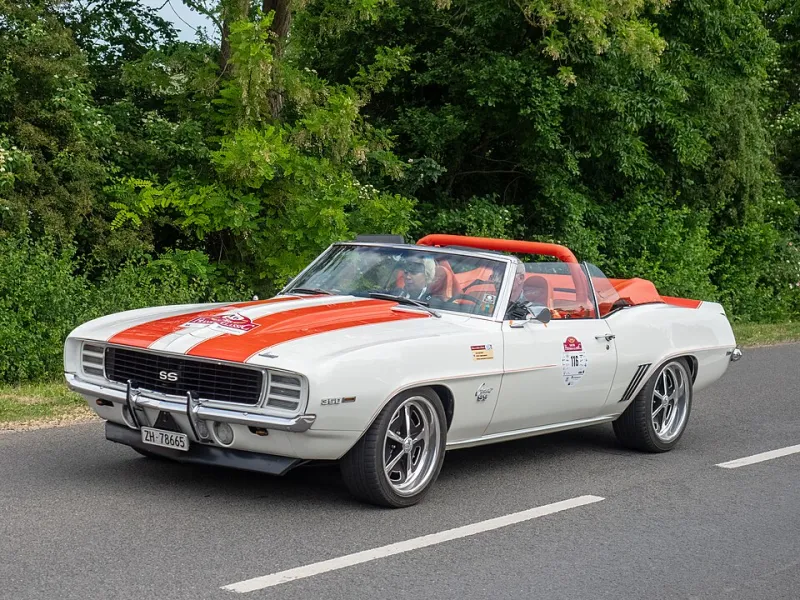
Photo: Ermell, CC BY-SA 4.0, via Wikimedia Commons
Every so often someone asks whether a Camaro SS makes any sense in Britain. Left-hand drive, seventeen miles to the gallon on a good day, a face that terrifies other drivers on a narrow B-road, and no main dealer network worth the name. On paper it's mad.
Then you open the bonnet. Pushrod V8, longitudinally mounted, acres of room around it, a sump plug you can reach without removing an undertray the size of a dining table, and an oil filter you can get to from above. No timing chain buried behind the bulkhead, no turbocharger wedged against the firewall. This is a car designed by people who assumed somebody might work on it.
That's the angle worth taking seriously in 2026. Plenty of modern performance cars are faster and cheaper to run. Very few of them let you do a full service on a Sunday morning with a trolley jack and a set of ramps.
Which one are we talking about?
Fifth generation ran 2010 to 2015 — the one that came back from the dead after the Camaro name had been resting since 2002. SS meant the 6.2-litre V8: LS3 with the manual gearbox, L99 with the automatic, the latter bringing cylinder deactivation and slightly less power but a bit more civility.
Sixth generation arrived in 2016 with the LT1, still 6.2 litres but a different animal — direct injection, more compression, more power, and available with the eight-speed automatic before a ten-speed turned up later in the run.
Both are straightforward to service. The sixth gen is more complex, more expensive on parts, and has a couple of well-known automatic gearbox quirks. The fifth gen is cruder, cheerfully so, and its faults are documented to death by a very large American owner community.
Fluid specs that actually matter
This is where UK owners get caught out, because the handbook in a US-market car speaks in quarts and Dexos specifications that don't map neatly onto what's on the shelf at Halfords.
- Engine oil. Follow the GM spec for your engine, not just the viscosity. The LS3 wants a 5W-30 meeting the older Dexos1 requirement; the LT1 spec shifted towards 0W-40 for harder use. A good quality fully synthetic in the right grade is fine, but don't guess — the wrong oil in a direct-injection LT1 is a genuine long-term risk.
- Coolant. Dex-Cool, the orange stuff. Mixing it with the blue or pink OAT coolants common in UK cars creates sludge. Flush properly if a previous owner has topped it up with anything else.
- Brake fluid. DOT 4, changed every two years regardless of mileage. These cars are heavy and fast; old fluid is a false economy.
- Gearbox. Manuals take a GM manual transmission fluid per the spec sheet. The 6L80 and 8L90 automatics are fussier — the eight-speed in particular has a specific fluid requirement, and getting it wrong is how you end up with the shudder that owners complain about.
- Differential. Synthetic 75W-90 GL-5 with the limited-slip friction modifier if you're on a factory LSD. Skip the modifier and you'll hear about it on tight turns.
A sensible service rhythm
Oil and filter every 5,000 to 6,000 miles is the habit most UK specialists recommend, particularly on short-hop use where the engine never gets properly hot. These are big lazy engines that don't mind mileage, but they do mind cold, stop-start town driving and long periods stood still over a British winter.
Plugs on the LS3 are a genuinely easy job and worth doing on schedule rather than waiting for a misfire. Air filter is a two-minute check. Brake fluid and coolant on time. That's about it for routine work — the rest is inspection.
Weak points worth knowing before they bite
Active fuel management lifters. The L99 and the automatic LT1s use cylinder deactivation, and the lifters on those cylinders are the classic failure point. Symptoms start as a tick on a cold start that doesn't go away. Ignoring it gets expensive quickly.
Torque converter shudder. The eight-speed automatic developed a reputation for a low-speed vibration that feels like driving over rumble strips. Often fluid-related; sometimes worse. Worth checking service history carefully.
Water pumps and thermostats. Plastic-bodied components on a hot V8 have a finite life. Not a big bill by performance-car standards, but a stranded-on-the-hard-shoulder bill if ignored.
Suspension bushes and tyres. Heavy car, wide tyres, rubbish roads. Rear subframe bushes and front tension arms take a beating on UK surfaces.
MOT, emissions and the left-hand-drive factor
The big one is headlamp aim. US-spec lamps can be adjusted, but a tester will fail anything with a beam that kicks up to the right, and some units simply can't be made compliant without swapping the lamp assemblies. Check this before you buy, not after.
Rear fog lamps are mandatory here and plenty of imports arrive without one. A neat, properly wired retrofit is fine; a dangling Halfords special will get picked up.
On emissions, a standard car with working catalysts usually passes the catalyst test without drama. A decat, a loud aftermarket system or a modified tune is where you'll come unstuck — and a US-market tune can also throw the lambda readings out enough to fail.
Speedometer isn't an issue, happily. US cars read in miles per hour as standard, which is precisely what a UK tester wants to see.
Buying parts without the import premium
The UK aftermarket covers consumables well — filters, brakes, fluids, belts, plugs. For anything deeper, the American suppliers are still the cheapest route, but you're paying shipping, duty and VAT on top, and returns become an international negotiation.
A few practical rules. Batch your orders so the shipping and handling fee is amortised across a proper job rather than one gasket. Use UK-based GM and American-car specialists for anything heavy or urgent. Check whether the part is shared with a UK-market Vauxhall VXR8 or a Holden — occasionally it is, and that's a lovely surprise. And keep a spreadsheet of what you've bought and from where, because you will forget which supplier shipped the right part.
Living with it
Be honest about the running costs. Fuel is the obvious sting, tyres are expensive at this size, and insurance for a left-hand-drive imported V8 requires a specialist rather than a comparison site. None of that changes.
What does change the maths is doing the labour yourself. A Camaro SS is one of the last modern GM performance cars where a competent home mechanic can handle the majority of the maintenance with ordinary tools, a decent jack, and a willingness to lie on cold concrete. In 2026, that's worth more than a few horsepower.